Tiny Tim
Tiny Tim, the youngest son of Bob Cratchit, is the frail, crippled child whose physical suffering and radiant spirit become the moral heart of A Christmas Carol. Though he appears in only a few scenes, his presence—and the threat of his death—transforms Ebenezer Scrooge's journey from miserly isolation to joyful generosity. Tiny Tim is not merely a pitiable figure; he is the story's most powerful symbol of the human cost of neglect and the redemptive power of love.
Identity and Condition
Tiny Tim is introduced as a boy who "bore a little crutch, and had his limbs supported by an iron frame" . His disability is both visible and severe: he cannot walk without assistance, and his father carries him on his shoulder. Despite his frailty, Tim is described as "as good as gold" by his father, who reports that the boy grows thoughtful sitting by himself and says "the strangest things you ever heard" . On the way home from church, Tim tells his father that he hopes the congregation saw him, a cripple, because "it might be pleasant to them to remember upon Christmas-day who made lame beggars walk and blind men see" . This remark reveals a gentle, theological innocence that contrasts sharply with Scrooge's cynical dismissal of the poor. Tim's physical condition is further emphasized by the "active little crutch" heard upon the floor and by the "iron frame" that supports his limbs . His voice is "plaintive" when he sings a song about a lost child in the snow , and his frailty is such that a breath might have withered him, as the Ghost of Christmas Past says of Scrooge's sister Fan .
The Cratchit Family Christmas
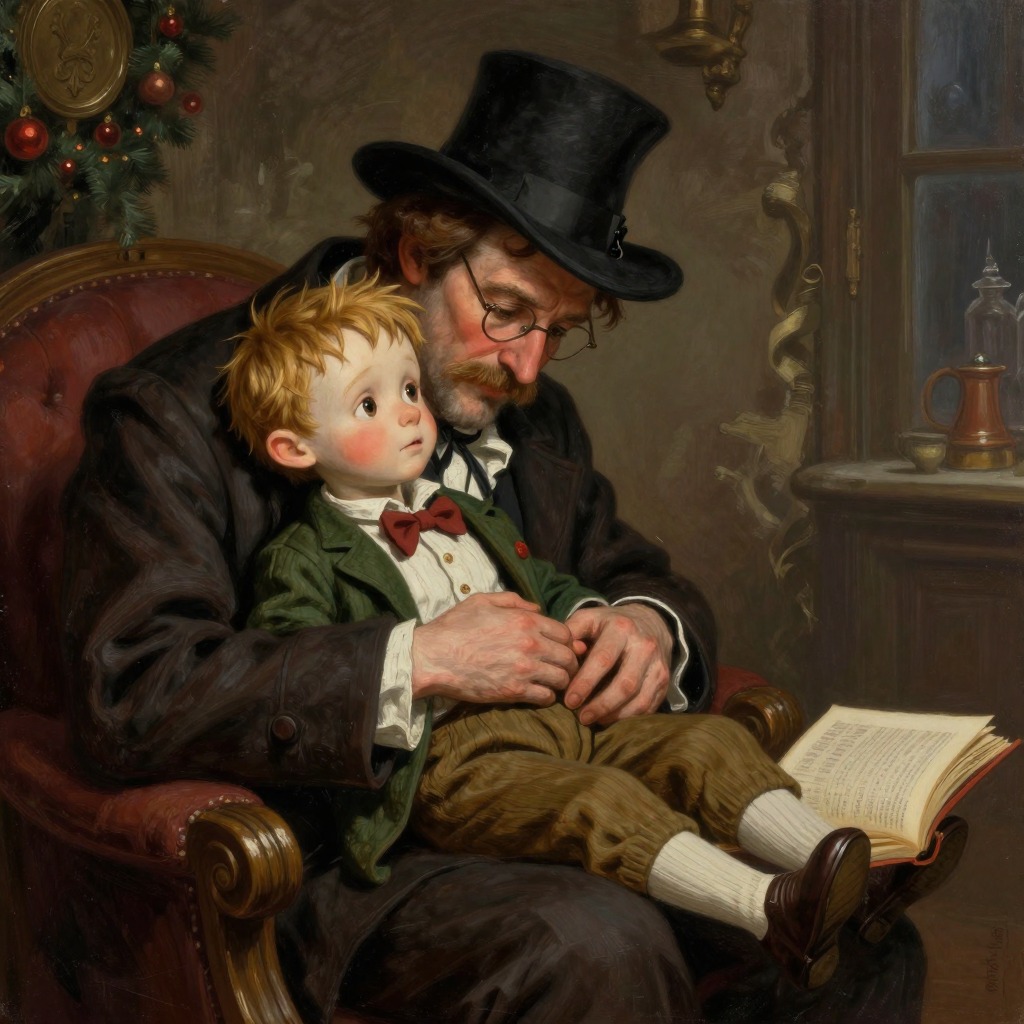
Tiny Tim is the emotional center of the Cratchit family's Christmas celebration. He sits beside his father at the table, and when the goose is served, he "beat on the table with the handle of his knife, and feebly cried Hurrah!" . After dinner, Bob Cratchit proposes a toast: "A merry Christmas to us all, my dears. God bless us!" and the family re-echoes it. Then Tiny Tim, "the last of all," says, "God bless us every one!" . This line, the most famous in the story, is Tim's signature utterance and encapsulates the inclusive, forgiving spirit of Christmas. He sits close to his father's side on his little stool, and Bob holds his "withered little hand" as if he loves the child and dreads that he might be taken from him . When Mrs. Cratchit reluctantly drinks to Scrooge's health, calling him "the Founder of the Feast," Tiny Tim drinks last of all, "but he didn't care twopence for it" . Scrooge is the "Ogre of the family," and his name casts a dark shadow on the party .
The Threat of Death and Scrooge's Intervention
The Ghost of Christmas Present shows Scrooge a vision of the future: "I see a vacant seat in the poor chimney-corner, and a crutch without an owner, carefully preserved. If these shadows remain unaltered by the Future, the child will die" . Scrooge, horrified, pleads, "Oh, no, kind Spirit! say he will be spared" . The Ghost cruelly throws Scrooge's own words back at him: "If he be like to die, he had better do it, and decrease the surplus population" . Scrooge hangs his head, overcome with penitence and grief . The Ghost then rebukes him, asking, "Will you decide what men shall live, what men shall die?" . This moment is the turning point of Scrooge's moral awakening: he sees the direct consequence of his philosophy of neglect. Later, in the vision of the future, the Cratchit household is quiet and grieving. Mrs. Cratchit says, "The colour hurts my eyes," referring to the bright color of a garment that reminds her of Tim . She recalls how Bob used to walk with Tim on his shoulder "very fast indeed" . Bob returns from the churchyard, where he has visited Tim's grave, and breaks down, crying, "My little, little child!" . The family's grief is palpable, and the Spirit of Tiny Tim is described as having "thy childish essence was from God" .
Redemption and a Second Father
After Scrooge's transformation, he becomes "a second father" to Tiny Tim, who "did NOT die" . Scrooge sends the Cratchits a prize turkey "twice the size of Tiny Tim" , raises Bob Cratchit's salary, and assists the struggling family. The narrative explicitly states that Scrooge "became as good a friend, as good a master, and as good a man as the good old City knew" . Tiny Tim's survival is the ultimate proof of Scrooge's redemption: the child who was doomed to die now lives, and Scrooge's newfound generosity has literally saved a life. The story ends with Tiny Tim's benediction, "God bless Us, Every One!" , which now carries the full weight of Scrooge's transformed heart.
Thematic Significance
Tiny Tim functions as the story's most potent symbol of innocence and vulnerability. His disability is not a personal failing but a condition that calls forth the best in others—his family's love, and ultimately, Scrooge's compassion. He represents the "surplus population" that Scrooge initially dismisses, and his survival demonstrates that every life has value. Tim's faith, expressed in his hope that his crippled body might remind others of Christ's miracles, contrasts with Scrooge's worldly cynicism. His role is to be the face of the poor and the weak, the one whose fate hinges on the choices of the powerful. In the end, Tiny Tim is not just saved; he becomes the living proof that Scrooge has learned the lesson that "Mankind was my business" .